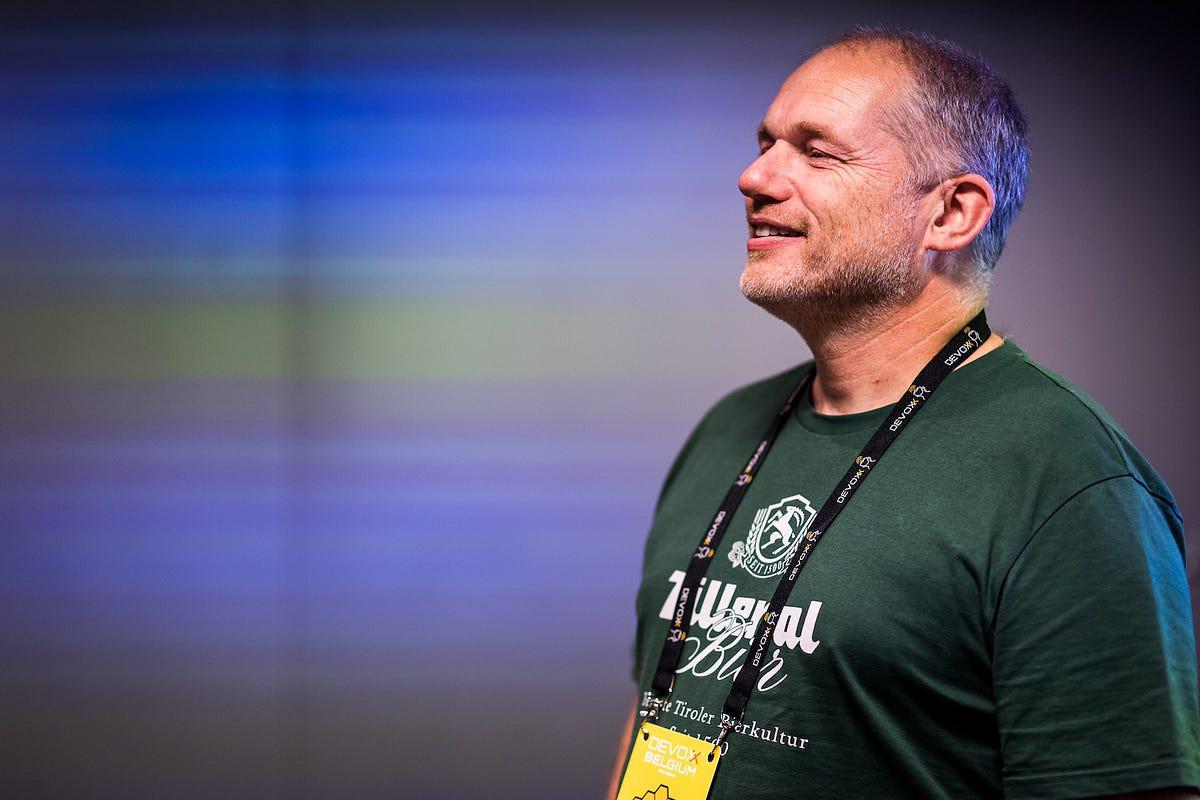

Shot taken during a workshop at Devoxx
It’s Sunday morning. I open my laptop, preparing slides for another talk and workshop. A week ago, I presented a session at Devoxx 2025. Together with Daniël Spee, I’ll be giving the same workshop at J-Fall, and in November, I’m speaking at the Apeldoorn IT event.
As I sit here, my thoughts drift. Why am I doing this? What is the true value of being a public speaker? That question led to this blog post.
When I started writing, I wasn’t sure whether the title should be My or The True Value of Public Speaking. In the end, I hope it’s both. I’d love this to be an interactive piece — because everyone has an opinion about public speaking. If you do too (and who doesn’t?), please share your thoughts in the comments.
My First Public Speaking Experiences #
My first talk was about Acegi, what later became Spring Security. I presented it at J-Fall 2005. I found an old blog post from Wiene Howeler about that conference — it even mentioned my talk.
I was supposed to present with a colleague, but he bailed out. I decided to continue alone. Preparing for a conference talk is the first real learning experience: you have to create a story and gain enough knowledge to tell it confidently. I don’t remember exactly how the presentation went, but based on Wiene’s post, I think I did fine. What I do remember clearly is that it left me wanting more.
In 2007, I shared the stage with Allard Buijze, speaking about web service versioning using OSGi. It was a great experience — presenting together added energy and fun. Later, I spoke with Byron Voorbach, and more recently, I’ve done many talks with Daniël Spee.
Conversations After the Talk #
One of the best parts of being a speaker is the conversations afterward. People come up to you with questions, feedback, or ideas. Those moments are gold — they help you learn and connect.
At that first talk about Acegi, I met Bram Smeets. We talked about joining jTeam (now Trifork). At the time, I had just moved from Capgemini to Accenture Technology Solutions, so I didn’t want to switch jobs right away. But we kept in touch. Three years later, I was ready for a change — and I did join jTeam.
Those post-talk chats can open unexpected doors.
Dealing with Feedback #
I found an old talk from 2014 at J-Fall titled “Returning the Right Results.” One of the reviews said I looked down at the audience. Even after more than a decade, I still remember that comment.
Overall, the feedback was positive, but that one line stuck with me. It didn’t feel fair — I never want to come across as arrogant or dismissive. Still, it taught me something important: feedback can sting, but it’s also a mirror. Sometimes it shows how others perceive you, even if it’s not how you see yourself.
Even after 20 years on stage, I know I still have a lot to learn. But not all comments help speakers grow — some simply discourage. It’s worth thinking about how we give feedback, not just what we say.
Support from Employers #
I’ve been lucky. Every employer I’ve worked for has supported my public speaking.
I started at Capgemini, continued at Accenture Technology Solutions, and became a regular speaker at jTeam. At my current employer, Luminis, it really took off. Speaking at Haystack USA remains a highlight of my career. For five years, Luminis even organized its own conference.
Through these opportunities, I’ve spoken in the Netherlands, Denmark, Sweden, Belgium, Germany, and the USA.
Some large conferences can sponsor speakers, but having an employer who covers travel, hotels, and preparation time is invaluable. I’m deeply grateful for that support — it made a huge difference.
Of course, it still takes a lot of time outside working hours. But the return on investment — personally and professionally — is enormous.
Networking (and Being an Introvert About It) #
I’m not a networking beast. I don’t naturally walk up to people at speaker dinners or chat with everyone after talks. But I do appreciate when others approach me.
My way of connecting is through contribution — being active in communities, forums, and on social media. Over time, that’s helped me build relationships before conferences, making it easier to connect in person.
That’s how I met people like Doug Turnbull, Charlie Hull, and more recently, Rod Johnson.
Being a speaker helps — people recognize you, and that lowers the barrier for conversation. I might not be the loudest person in the room, but I deeply value the connections that speaking creates.
Learning Through Speaking #
Public speaking is one of the best ways to learn. It starts with the proposal: choosing a topic that’s interesting for others and relevant to you. Often, I pick a subject I want to learn about myself. That’s a challenge — once you’re accepted, you have to master it and create a compelling story.
While preparing slides and crafting your narrative, you internalize knowledge. You start understanding the “why” behind things, not just the “how.”
As we at Luminis like to say:
“Knowledge is the only thing that grows when you share it.”
The Business Perspective #
So far, I’ve talked about personal growth. But what about the business value of public speaking? Why do companies care?
Most conferences are sponsored by companies looking to build visibility, attract customers, or hire talent. Having a speaker on stage strengthens that presence. If your company also has a booth, it draws even more people — some come specifically to talk to the speaker.
In fact, one of my colleagues joined Luminis after seeing me speak at an event. It works.
With many conferences now publishing talks online, the visibility extends far beyond the event itself. It’s free publicity, and sometimes it leads to real business opportunities.
For example, my talks about search-related topics have sparked new client connections in government, retail, and other sectors. Some of those relationships started — or deepened — through a talk or blog post.
Conclusion: The Real Value #
It’s hard to measure the exact value of being a public speaker. But for me, it’s been essential to both my career and my motivation.
I’ve expanded my network, met incredible people, discovered new opportunities, and even changed jobs because of it.
For companies, the benefits may be less direct, but they’re real — public speakers amplify brand visibility, create trust, and inspire others.
For individuals, it’s even more powerful: you grow, you learn, and you give back.
So that’s my story.
What about you? What’s the true value of public speaking for you?